Underground Compressed Air with High Density Fluid
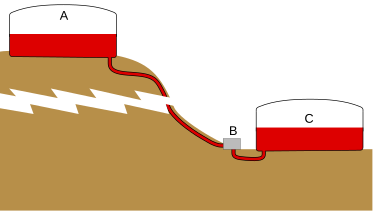
I think this is a reasonably good schematic diagram of the Rhe Energise system. It is basically similar to a normal pumped storage scheme, except that instead of water, it uses Rhe Energise’s proprietary high density fluid (R-19). This is 2.5x the density of water, allowing the use of much smaller height differences between reservoirs, or giving substantially increased energy capacity, or a bit of both. Importantly, R-19 is reasonably cheap and environmentally benign. A and C are the upper and lower reservoirs, covered to avoid dilution with rainwater. B is the pump/turbine unit. To allow the salient features to appear at a sensible scale most of the (particularly the vertical) distance between A and B is omitted. |
 | |
I think this is a reasonably good schematic diagram of the basic Hydrostor system. (See Underground Compressed Air for a general description.) A is the surface level water reservoir. D is the air compressor/turbine unit – heat store not shown. F is the rock cavity, containing a variable volume of compressed air displacing water at approximately constant pressure. |
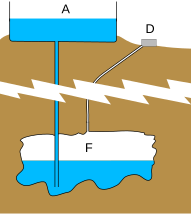 | |
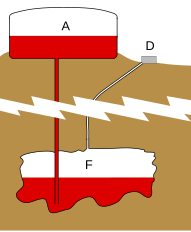
Assuming that the overburden is denser than R-19, the water in this system could safely be replaced with R-19, thereby considerably increasing the energy capacity of the system. (And if anything, the increased pressure will probably improve the stability of the cavity F.) D would be working at a considerably higher pressure, and the heat store would need to be larger. A cover over the reservoir would be necessary. (Is there any possible issue here with any of R-19’s components separating out in the rock cavity, as a result of interaction with the rock and/or high pressure air? Would a lining be necessary? What, if any, limits are there to the pressure R-19 can be put under?) |
 | |
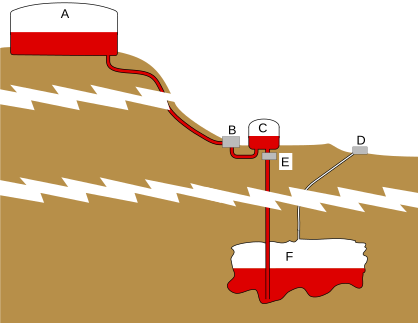
I don’t know whether any Hydrostor schemes are like this, but I don’t see any reason why they shouldn’t be. The reservoir is now up a possibly sizeable hill, whereas the rock cavity is under somewhat less overburden – but as the density of the overburden is considerably greater than the density of the water, as long as the height ratio is not excessive, the cavity can safely contain the higher pressure. E, which may or may not be worthwhile* houses a stop valve to shut off the connection between A and F whenever the system is neither charging nor discharging, to minimise the loss of air. Air which diffuses (in solution) up the pipe from F to E will then form bubbles and be trapped below E. Losses of air will be limited to the volume of the pipe (at full working pressure) from F to E per cycle – but will generally be much less unless the cycle time is very long. E also houses an air release valve to vent this before the stop valve is opened, to avoid issues with bubbles of high pressure air entering the penstock. This could vent into a tapering pipe (not shown) reaching above the maximum level of water in A, to minimise stress on the valve, which would only shut when the water velocity had diminished. This vent pipe should then have a drain valve for the water. It would be possible to put E further down the system to reduce the loss of air each cycle, but at the cost of greater complication and more difficult maintenance. This is unlikely to be worthwhile. It might even be best to put E close below A. In general, you could not simply replace the water in this system with R-19, as the pressure in the rock cavity would probably be sufficient to disrupt the overburden. * Depending on storage timescales, pipe diameter - which itself depends on charge and discharge rates - horizontal distance, and vertical distance and consequently pressures. |
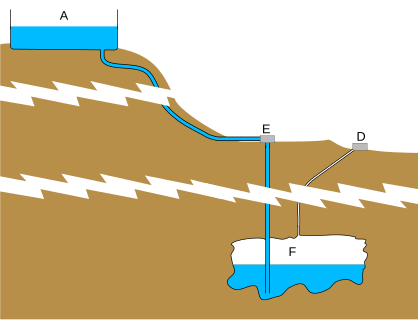 | |
Nonetheless, even in a location like this, there is potential for a useful synergy between the two systems, as shown. The energy stored in the compressed air in F is similar to what it was before, but we now have the pumped storage system A and B in addition – but instead of two large reservoirs for each system, they now only have one large reservoir each, and share a much smaller compensation reservoir C between them. D should house a pressure relief valve if C is not designed to overflow in the event of a failure of B resulting in the fluid in A draining down. The stop valve and air release system E may be necessary with R-19 even if it is not with water – I know nothing about the solubility or rate of dissolution of air in R-19 at high pressure, and pipe diameters may need to be greater too. (The air vent pipe’s drain valve in this case must of course drain into reservoir C, whereas in the water system it would flow to waste.) |
 | |